The Best North Texas Suburbs If You Still Commute
Straight-line distance lies in this metro. Which corridors actually move, where the reverse commute is the whole answer, and what rail changes.
The commute is the constraint that shapes every other part of a housing search, and it is the one most people estimate rather than measure.
In this metro that estimate is unusually likely to be wrong, for two specific and fixable reasons.
Why Straight-Line Distance Lies Here
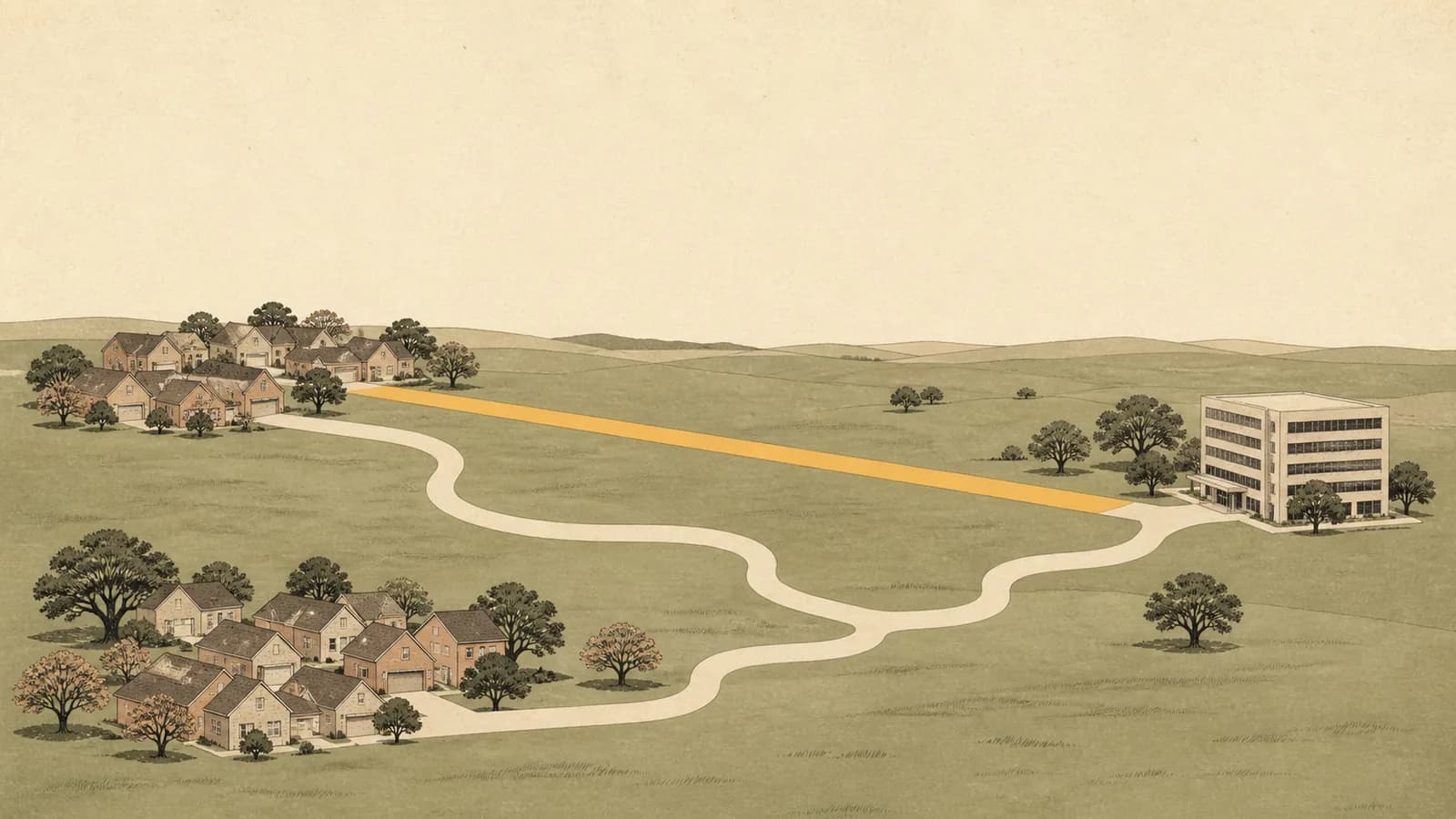
North Texas has lakes, a tollway network with limited crossings, and a road grid interrupted in inconvenient places. The result is that map distance and drive time come apart badly.
The clearest example: Rowlett is 16.1 straight-line miles from downtown Dallas and Plano is 17.6. By road, Rowlett is 19.5 miles and about 27 minutes, while Plano is 19.0 miles and about 23. Lake Ray Hubbard is in the way, and the map does not tell you that.
That is not a rounding error. It is large enough to reverse a ranking, which is why the neighborhood matcher scores commute on real road routing and refuses to mix routed times with straight-line estimates in the same comparison. A screen scored half one way and half the other is two rankings interleaved.
The same distortion applies to everything east of the lakes, anywhere the tollway is the only sensible route, and anywhere a highway gap forces a detour. The Rockwall version of this problem.
Congestion Is Directional
This is the piece of local knowledge worth the most and it appears in no relocation packet.
In the morning the dominant flow is southbound and inbound toward Dallas and the airport corridor. In the evening it reverses. If your office is north of you, or if you are travelling outbound in the morning, you are driving against the flow in both directions.
Two practical consequences:
- A longer reverse commute frequently beats a shorter one with the flow. Living north of a Legacy corridor office can produce a faster drive than living south of it, despite the extra distance.
- Averages are useless. A route that averages 25 minutes may be 18 one way and 38 the other, and you experience both.
Nobody factors this in when choosing a city, and it is checkable in one morning. The corridor map for the Legacy employment area.
By Where You Actually Work
This metro has several employment centres rather than one, and the right answer differs completely between them.
| If you work in | Look first at | Also consider |
|---|---|---|
| Legacy West and the Frisco tollway corridor | West Plano, southern Frisco | The Colony, Little Elm, west Allen |
| Downtown Dallas | Richardson, Plano, Garland with rail | Rowlett, Carrollton, Addison |
| DFW Airport and the northwest corridor | Coppell, Carrollton, Flower Mound | Lewisville, Addison, Grapevine area |
| The Richardson telecom corridor | Richardson, east Plano, Garland | Sachse, Murphy, Wylie via the turnpike |
| McKinney and the northern corridor | McKinney, Allen, Melissa | Anna, Princeton, Prosper |
| East of the lakes | Rockwall, Heath, Royse City | Rowlett, Garland |
One general rule that holds across all of them: the cities that look cheap on a listing site are cheap partly because of where they are relative to jobs. That is not a hidden flaw, it is the trade, and it is only a bad trade if you did not price it. Where the affordable suburbs are.
What Rail Changes, and Where It Exists
Rail in North Texas is not a substitute for a car for most households. What it does change is whether a household can run one car instead of two, and whether a teenager can get places without a parent driving.
Where it exists in the northern suburbs:
- Richardson, five stations across three lines including a rail connection toward the airport. The strongest transit position in the northern suburbs.
- Carrollton, three Green Line stations, the A-train, and Silver Line service to DFW Airport.
- Plano, rail service including the northern terminus of the Red Line.
- Addison, a Silver Line station with a one-seat ride to the airport.
- Garland and Rowlett, on the eastern side.
Where it does not: Frisco, Allen, Prosper, McKinney and Celina are not DART member cities and have no stations. If rail matters to your household, that fact alone eliminates a large part of the Collin County corridor, and it is worth knowing before you spend three weekends there. What rail does to home values.
How to Test a Commute Properly
- Drive it. Twice. Once at your real morning departure time, once at your real evening one. Not on a Saturday, not at ten in the morning.
- Do it from the specific address, not from the city centre. Within a large suburb the difference between two neighborhoods can be fifteen minutes.
- Note the variance, not just the time. A route that is reliably 30 minutes is better than one averaging 25 with a range of 15 to 50, because you cannot plan around variance.
- Check for a single point of failure. If one bridge, one tollway or one interchange carries your whole route, an incident there has no alternative.
- Convert it into hours and money. Forty minutes each way is roughly seven hours a week and about twenty thousand additional miles a year. Price that against the housing saving.
- Then score it against everything else in the neighborhood matcher, which uses real routing rather than distance.
And if you have stopped commuting entirely, the ranking changes completely and most of this post stops applying: the best North Texas suburbs if you work from home.
Frequently Asked Questions
Which DFW suburbs have the best commute?+
It depends entirely on where you are going, because this metro has several distinct employment centres rather than one. For the Legacy and Frisco corridor, west Plano and southern Frisco. For downtown Dallas, Richardson and Plano with rail. For the airport corridor, Coppell, Carrollton and Flower Mound.
Is straight-line distance a good guide to commute time in DFW?+
No, and it is misleading enough to invert a ranking. Lakes, limited crossings and tollway access mean two places equidistant on a map can differ by fifteen minutes each way. Rowlett is closer to downtown Dallas than Plano as the crow flies and further by road, because Lake Ray Hubbard is in the way.
What is a reverse commute in DFW?+
Travelling against the dominant flow: outbound from the core in the morning and inbound in the evening. Because congestion here is strongly directional, a reverse commute over a longer distance frequently takes less time than a shorter one with the flow, and almost nobody factors this in when choosing where to live.
Which North Texas cities have DART rail?+
Plano, Richardson, Carrollton, Addison, Garland and Rowlett are among the member cities with stations, and Carrollton and Addison also have Silver Line service toward DFW Airport. Frisco, Allen, Prosper, McKinney and Celina are not DART member cities and have no rail service at all.
How long is too long for a commute?+
That is personal, and it is worth converting into hours before deciding. A forty-minute each-way drive is about seven hours a week and roughly 350 hours a year, plus the vehicle cost of around twenty thousand additional miles. Price that against the housing saving before concluding the trade is worth it.
Run Your Own Numbers
About the Author

Licensed Realtor · DFW North Texas
Specializing in Plano, Frisco, McKinney, and Allen. Helping buyers and sellers navigate North Texas since 2015, with honest advice, deep local knowledge, and no pressure.
You Might Also Like
McKinney vs Frisco, TX: Which City Is Right for You? (2026)
Comparing McKinney and Frisco, TX? Both are popular DFW suburbs that feel very different - an honest side-by-side on prices, schools, and commute.
· 5 min read
Is DFW Safe? How to Actually Compare North Texas Cities on Livability
Where the published numbers come from, why most safest-suburbs lists are unusable, and how to read the real sources instead of a score somebody invented.
· 6 min read
Cash Flow vs Appreciation in DFW: Pick One Honestly
Almost nothing in this metro does both well at once. What each strategy needs from you, and how to tell which one your balance sheet can actually survive.
· 6 min read