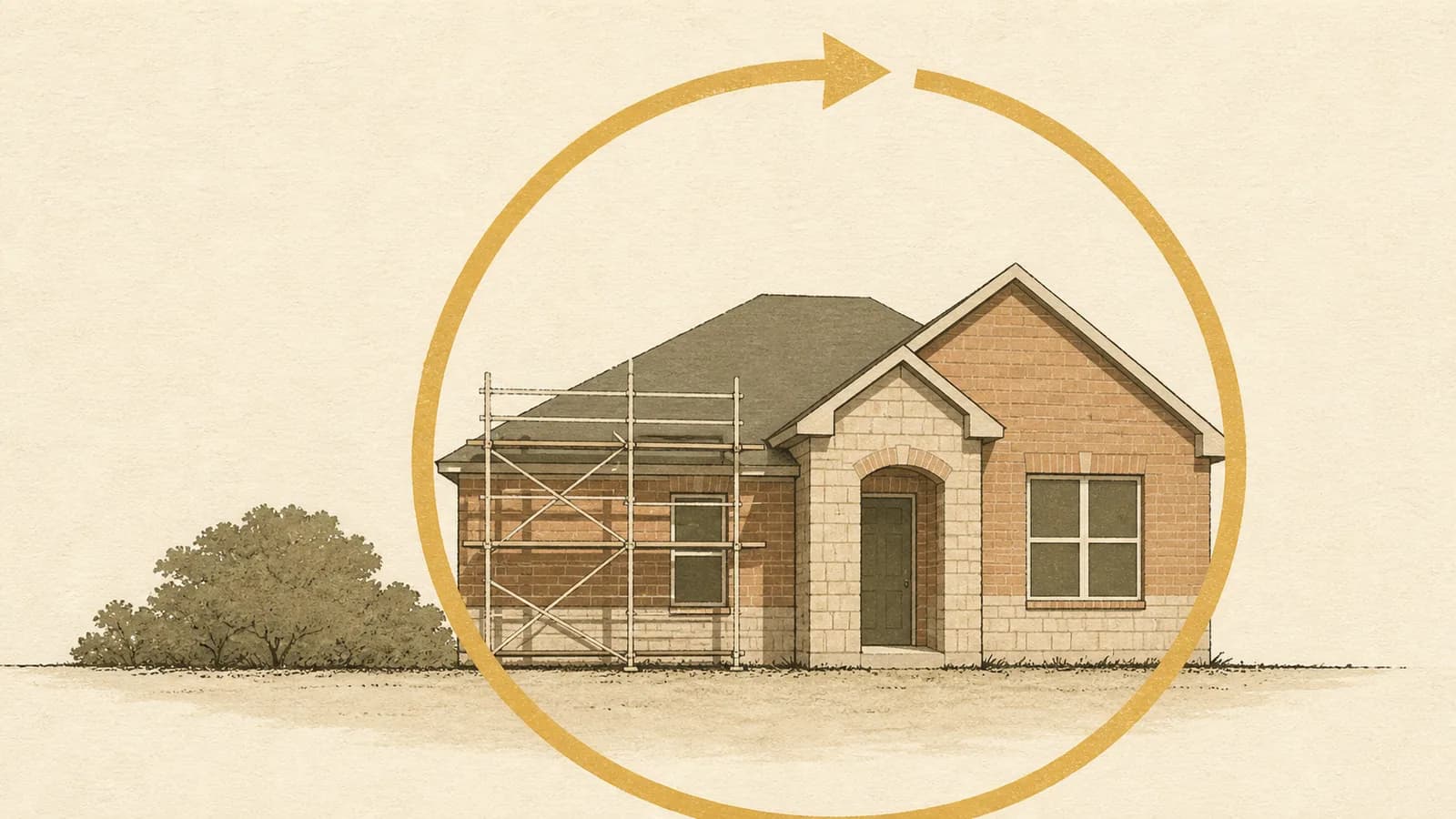
BRRRR in North Texas in 2026: Does the Math Still Work?
Buy, rehab, rent, refinance, repeat - on a real Garland deal at a 7.5% cash-out rate. The capital recycles. The cash flow doesn’t. Here’s the number that decides it.
BRRRR still recycles your capital in North Texas. It just hands you a property that loses about $1,100 a month while it does it.
Buy, rehab, rent, refinance, repeat. The appeal is obvious: if the refinance returns most of what you put in, you can do it again without raising new money, and the same dollars compound across a portfolio. That worked extraordinarily well in this metro for about a decade.
Two things changed. Cash-out rates on investment property went to 7.5%, and North Texas prices ran far ahead of North Texas rents. Below is a real deal, priced line by line, so you can see exactly where it breaks - and what would have to be true for it not to.
A Real Deal, Priced Out
Garland, because it is where the entry prices and the rent-to-value ratios in this metro are least bad. A distressed three-bedroom at $220,000, a $45,000 rehab, and an after-repair value of $360,000. Financed conventionally at 20% down, held four months through the rehab.
| Cash into the deal | Amount |
|---|---|
| Down payment (20% of $220,000) | $44,000 |
| Purchase closing costs | $5,000 |
| Rehab budget | $45,000 |
| Holding costs (4 months @ $1,800) | $7,200 |
| Total cash in | $101,200 |
Note the holding costs. Four months of debt service, tax, insurance, and utilities on a property earning nothing is $7,200 - and four months is optimistic for a rehab of this size. Every month the contractor slips costs you $1,800 in cash you will not get back at the refinance.
The Refinance: What Comes Back
This is the part that works, and it is worth giving it full credit before taking it away.
After the six-month seasoning period most cash-out lenders require, the property appraises at $360,000. A refinance at 75% loan-to-value writes a new loan of $270,000. That retires the $176,000 acquisition loan and leaves $94,000 gross, less about $6,500 in refinance closing costs - so roughly $87,500 comes back to you.
Against $101,200 in, that leaves about $13,700 in the deal. You control a $360,000 asset for under fourteen thousand dollars of trapped capital. That is a genuinely good outcome and it is the entire reason the strategy has adherents.
Then the property starts operating.
Then the Cash Flow Arrives
The house rents for $2,400 a month. Here is what it costs to own it, stabilized.
| Monthly, after refinance | Amount |
|---|---|
| Gross rent | $2,400 |
| Less vacancy (5%) | -$120 |
| Effective rent | $2,280 |
| Principal & interest ($270,000 @ 7.5%) | -$1,888 |
| Property tax (Garland, 2.39%) | -$717 |
| Insurance (0.9% of value) | -$270 |
| Management (8%) | -$192 |
| Maintenance (8%) | -$192 |
| Capex reserve (5%) | -$120 |
| Monthly cash flow | -$1,099 |
Negative $1,099 a month. About $13,200 a year - which is, almost exactly, the $13,700 you left in the deal. You recycled your capital and bought an obligation that consumes the same amount every single year.
And this is the honest version. Charge nothing for vacancy, nothing for capex, nothing for management, and use an insurance placeholder instead of a quote, and the same deal shows about -$595- still negative, but survivable-looking. That is how these deals get sold. Those four omitted lines are not conservatism; they are the roof, the turnover, and the month the tenant leaves.
Why This Broke
One ratio explains nearly all of it. The property is worth $360,000 and rents for $2,400 - a 0.67% rent-to-value. The old shorthand said you wanted 1%. This deal is a third short, and no amount of clever financing closes a gap that size.
Two forces opened it. North Texas home values compounded at 6% to 8% a year for a decade while rent growth has run 2.3% in Garland and under 1% in several newer submarkets, because DFW absorbed a record wave of apartment supply. Prices ran; rents walked.
Then the exit rate repriced. At a 6.5% cash-out rate this deal loses about $930 a month; at 7.5% it loses $1,099. That single point is roughly $170 a month, and for deals that were marginal rather than hopeless, it is the whole margin.
There is a trap inside the tax line, too. Garland's 2.39% effective rate is high because Dallas County funds a hospital district that Collin County does not. So the submarkets with the best rent-to-value in this metro also carry the worst tax rates - Rowlett is 2.51%. The cheap entry price and the expensive carry are the same fact viewed from two sides.
And the refinance is levered to an appraisal in a market that is down about 4.4% year over year in Garland. Your ARV is an assumption a stranger will confirm or deny six months after you have spent the rehab money.
What Still Works
Deals still clear in this metro. They are narrower than they were, and they share features.
- A genuinely lower basis. The fix is not a better rate; it is a cheaper purchase. Run the deal above at $175,000 instead of $220,000 and the arithmetic changes shape. This is why the buy is the only letter in BRRRR you fully control.
- Rent-to-value at or near 1%. Which in practice means the lower-priced Dallas County submarkets, and accepting their tax rates with open eyes.
- Less leverage at the exit. Refinancing at 65% instead of 75% leaves more capital trapped but cuts the payment by roughly $250 a month. Sometimes the right answer is to recycle less and own something that pays for itself.
- Forced appreciation you can defend. An ARV supported by three closed comparable sales within six months and a half mile - not by a spreadsheet and optimism.
- Multi-unit, where the rent-to-value ratios are structurally better and one vacancy is not 100% of your income.
The Screen to Run First
Before underwriting anything in detail, screen on rent-to-value and throw out everything under about 0.8%. It takes seconds and it eliminates most of what you would otherwise spend a weekend modeling.
The property screener does exactly this across North Texas, and the market finder ranks the submarkets themselves on yield, entry price, and growth. One caution worth stating plainly, because it applies to every yield screen including ours: the underlying data has no listing status, so a match is a property whose numbers work, not a property that is for sale. Treat the output as a shortlist of places to go looking, not as inventory.
It also reports gross yield rather than a cap rate, deliberately. There is no per-parcel tax, insurance, HOA, or vacancy figure available at screening scale, so a cap rate there would be a precise-looking number that is quietly wrong. Net figures belong in the BRRRR calculator and the rental analyzer, where you supply the inputs.
The Verdict
BRRRR is not dead in North Texas. It has stopped being a strategy you can execute on the median deal and become one that requires an genuinely below-market purchase - which means off-market sourcing, real relationships, and the discipline to pass on almost everything.
The failure mode to avoid is the one this post exists to name: being so pleased that the refinance returned your capital that you do not notice the asset it left behind loses more every year than the capital you rescued. Both halves have to work. Run the refinance and the stabilized cash flow before you buy, not after.
If a deal clears both, it is worth moving on quickly - those do not sit. If it only clears the first, you have not found a deal. You have found a way to finance a loss.
Frequently Asked Questions
Does BRRRR still work in North Texas in 2026?+
The capital-recycling half still works; the cash-flow half mostly doesn’t. On a representative Garland deal - $220,000 purchase, $45,000 rehab, $360,000 ARV - a 75% cash-out refinance returns nearly all of your capital and leaves under $15,000 in the deal, which is the outcome BRRRR exists to produce. But at a 7.5% investor cash-out rate, that same property rented at $2,400 a month runs roughly $1,100 a month negative once you charge real vacancy, tax, insurance, management, maintenance, and capex. You get your money back and buy a monthly liability with it.
What interest rate does a BRRRR refinance actually cost?+
Materially more than the owner-occupied rate people quote. A 30-year fixed cash-out refinance on an investment property runs around 7.5% in mid-2026 - composed from roughly a 6.79% national refinance average plus the 50 to 100 basis point investment-property cash-out premium. That is nearly a full point above the 6.55% owner-occupied purchase rate. On a $270,000 refinance loan, the difference between 6.55% and 7.5% is about $170 a month, which is often the entire margin a deal was underwritten on.
What is the 1% rule and does anything in DFW meet it?+
The 1% rule says monthly rent should be at least 1% of the all-in price - a $250,000 property should rent for $2,500. It is a screen, not an underwrite. Most of the North Texas properties investors are drawn to fail it badly: a $360,000 house renting at $2,400 is 0.67%, which is why it cannot cash flow at 7.5%. Rent-to-value that clears 1% in this metro is concentrated in the lower-priced Dallas County submarkets, and it comes with higher property tax rates - Garland at 2.39% and Rowlett at 2.51% versus Plano at 1.71%.
How much cash do you actually leave in a BRRRR deal?+
On the deal modeled here, about $13,700. You go in with roughly $101,200 - a $44,000 down payment, $5,000 in purchase closing costs, $45,000 of rehab, and $7,200 of holding costs over four months. The refinance at 75% of a $360,000 ARV writes a $270,000 loan, retires the $176,000 acquisition loan, and returns about $87,500 after $6,500 in refinance closing costs. That recycling is genuine and it is why the strategy is attractive. The question this post is about is what the recycled capital has bought you.
Should I use a cap rate to evaluate a BRRRR deal?+
Use it late, not early, and never from a listing. A cap rate is only as good as the operating expenses underneath it, and the ones that get omitted are always the same four: vacancy, capital expenditure reserves, management, and a real insurance quote rather than a placeholder. On a DFW rental those four are roughly 5%, 5%, 8%, and 0.9% of value a year. Omit them and a deal that loses $1,100 a month presents as a respectable cap rate. Build the number from inputs you supply, and be suspicious of any figure you didn’t assemble yourself.
Is negative cash flow ever acceptable on a rental?+
It can be a deliberate position, but it has to be one you chose rather than one you discovered. Feeding a property $1,100 a month is a bet that appreciation and rent growth will outrun the shortfall - and right now North Texas prices are down year over year in every city we track, with Garland off about 4.4%, so that bet is being made into a falling market. The failure mode is not the monthly loss; it is that the loss removes your ability to hold through the downturn the loss is predicated on surviving.
Run Your Own Numbers
About the Author

Licensed Realtor · DFW North Texas
Specializing in Plano, Frisco, McKinney, and Allen. Helping buyers and sellers navigate North Texas since 2015, with honest advice, deep local knowledge, and no pressure.
You Might Also Like
The 1% Rule in DFW: What Actually Exists in 2026
No North Texas city we track clears 1% rent-to-value. Dallas tops out at 0.74% and Frisco sits at 0.47%. Here’s the full table, and what to screen on instead.
· 7 min read
Garland, TX Real Estate: The Affordable DFW Suburb (2026)
Garland, TX offers some of the best values in DFW - close to Dallas, with DART rail, lakefront options, and prices 30-40% below Plano for similar homes.
· 6 min read
The Ag Valuation on North Texas Land: What It Saves and What Breaks It
It is a valuation, not an exemption, and losing it triggers a rollback assessment. What qualifies, what the history requirement means, and who pays when it ends.
· 6 min read