The Survey and the T-47: What Blows Up a Texas Closing
Whether you need a new survey, who pays, what the T-47 affidavit actually promises, and the fence line that costs three weeks and a missed closing date.
The survey costs a few hundred dollars and is the single most common reason a Texas closing slips a week. Not because it is complicated, but because it has a lead time and nobody thinks about it until the title company asks.
What a Survey Actually Shows
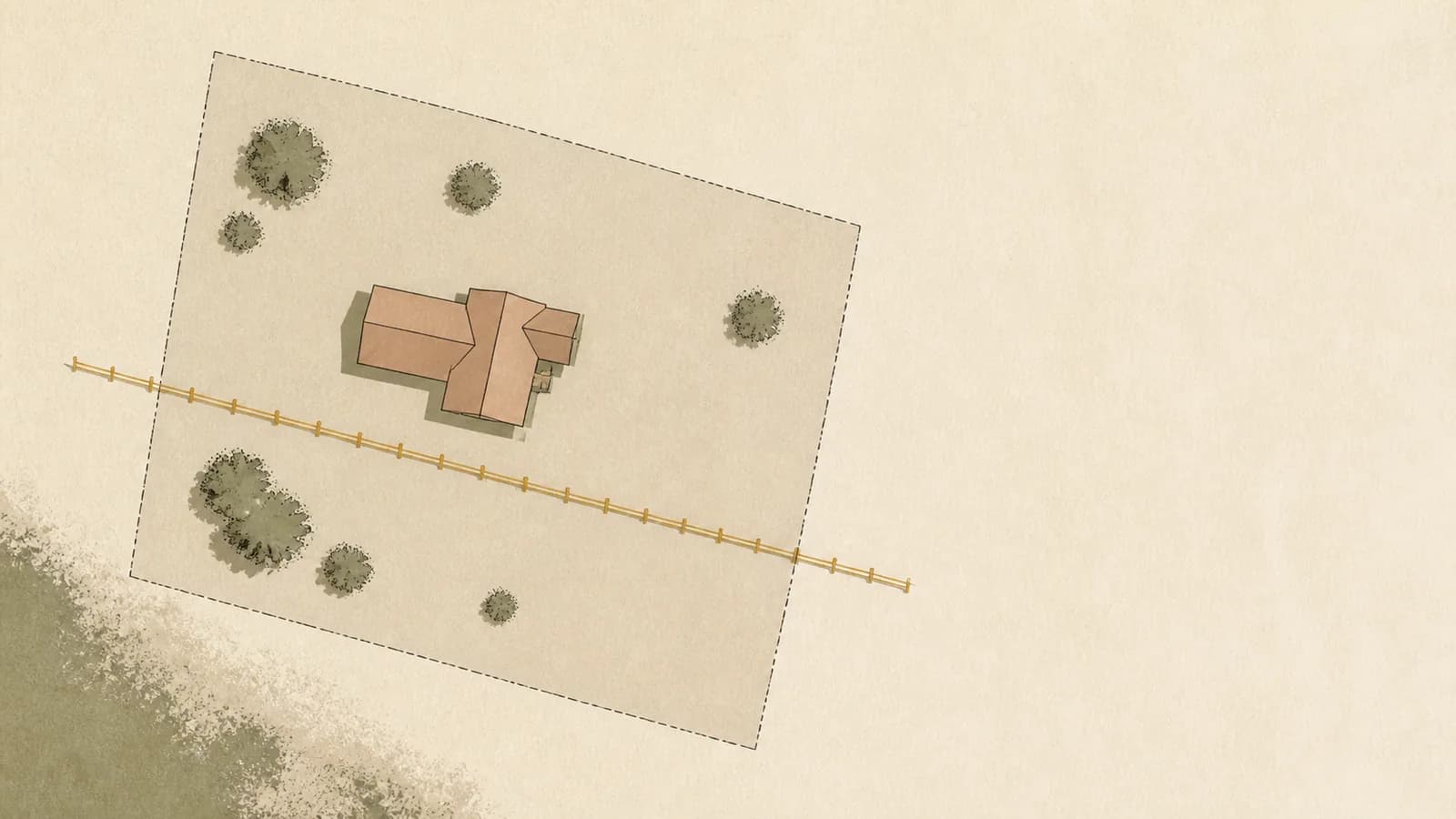
A residential survey is a drawing of the property boundaries with everything on the land located relative to them. It shows:
- The boundary lines and the recorded legal description
- The footprint of the house and any outbuilding, and where each sits within the setbacks
- Easements of record, including utility, drainage and access
- Fences, driveways, decks and pools, and whether they cross a line
- Encroachments in either direction
It is not an inspection and it says nothing about condition. What it answers is: where does this property end, and is anything in the wrong place.
It also matters to your title policy. By default the policy takes exception to any matter a correct survey would show, and the survey deletion endorsement narrows that exception. No acceptable survey, no endorsement. How the title policy works.
Paragraph 6C: The Three Choices
The promulgated contract handles this in paragraph 6C, and the offer selects one of three approaches. Getting this right when writing is the difference between a smooth transaction and a scramble.
| Approach | How it works | Risk |
|---|---|---|
| Seller provides existing survey plus T-47 | Fastest and cheapest, if the survey is acceptable to the title company and lender | It gets rejected and a new one must be ordered late |
| Buyer obtains a new survey | Buyer orders and pays | Cost, plus the lead time if ordered late |
| Seller obtains a new survey | Seller orders and pays | Timing depends on the seller acting promptly |
The first option is where most delays originate, because it depends on two things going right: the seller actually having the survey, and the title company accepting it. Neither is guaranteed and both are discovered late.
The T-47 Affidavit, and Why Sellers Hesitate
The T-47 is a sworn statement by the seller that the existing survey still accurately reflects the property. No new fences, no added structures, no changed boundaries, no new encroachments since it was made.
It is sworn under penalty of perjury and notarised, which is exactly why some sellers decline to sign it. A seller who put in a pool, moved a fence, added a shed, or simply does not remember what has changed over twelve years of ownership has a rational reason to hesitate.
Do not read a refusal as evasion. Read it as information: something has probably changed, and a new survey is the right answer. The useful move is to ask early, in the first days of the option period, rather than to discover it when the title company chases the file in week three.
What Goes Wrong, in Order of Frequency
- Nobody orders it. Everyone assumes someone else is handling it and the title company asks ten days before closing. New survey, two-week lead time, closing moves. This is the most common failure and it is entirely preventable.
- The fence is not on the line. Extremely common in older neighborhoods, where fences were put up by agreement or by guesswork decades ago. Usually resolvable, sometimes with a boundary agreement, and it always takes time.
- A structure sits in an easement. A shed, a pool deck or an addition built over a utility easement. The utility retains its rights regardless, so this needs to be understood rather than ignored.
- An addition crosses a setback. Often unpermitted work by a previous owner. It may need a variance, and that is a municipal timeline, not a real estate one.
- The existing survey is too old or too poor to use. The title company decides, not the parties.
Notice that four of the five are discoverable on day two of an option period and expensive on day thirty. The entire management of this issue is timing.
Who Pays, and Why It Is Worth Negotiating
North Texas custom often has the seller providing an existing survey or paying for a new one, but custom is not law and paragraph 6C is where it is decided.
It is a genuinely negotiable line worth a few hundred dollars, which puts it in the same category as the residential service contract and the HOA transfer fee: small enough that a seller will often concede it to close a wider gap, and large enough to be worth asking for. Where it sits among the other closing costs.
One practical note for buyers: if you pay for the survey, you own it. Keep the original. You will want it when you build a fence, add a pool, or sell the house, and having it saves the next transaction the same scramble.
On Acreage, It Is Not Optional
Everything above is about a normal platted suburban lot, where boundaries are well recorded and mostly uncontroversial. On land the calculation changes completely.
On acreage in Lucas, Fairview, Parker or the rural fringe, the survey is where you learn about:
- Actual acreage, which is frequently not what the listing says
- Road frontage and legal access, which determines whether you can build
- Pipeline and utility easements, which can cross a large share of a tract
- Shared driveways and access agreements
- Floodplain boundaries relative to your building site
- Old fence lines that do not match the deed, sometimes by a meaningful margin
On a land purchase, order a new survey, always, and read it with your agent before the option period ends. The full acreage diligence list, and the large-lot cities where this comes up most: Lucas and Fairview.
Frequently Asked Questions
Do you need a new survey to buy a house in Texas?+
Not always. If the seller has an existing survey and provides it along with a T-47 affidavit confirming nothing has changed, the title company can often use it. Whether that is acceptable is the title company's and lender's decision, not yours or the seller's, and they will reject it if the property has visibly changed.
What is a T-47 affidavit in Texas?+
It is a sworn statement by the seller that the existing survey still accurately reflects the property, that no new improvements, fences, additions or encroachments have appeared since it was made. It lets the title company rely on an older survey rather than requiring a new one. It is sworn under penalty of perjury, which is why some sellers decline to sign it.
Who pays for the survey in Texas?+
It is negotiated in paragraph 6C of the promulgated contract, and North Texas custom often has the seller providing an existing survey or paying for a new one. It is one of the more genuinely movable items in a contract, worth a few hundred dollars, and it is frequently traded as part of a wider negotiation.
What happens if the survey shows an encroachment?+
It becomes a title matter. Depending on what it is, the resolution might be a boundary line agreement, a recorded easement, moving the structure, or the title company agreeing to insure over it. All of those take time, which is why finding out in week one rather than week four is the whole game.
How long does a new survey take in Texas?+
Typically a week or two, and longer when surveyors are busy or the property is large or unusual. That is why the survey is such a common cause of a delayed closing: it is a small cost with a long lead time, and nobody thinks about it until the title company asks.
Run Your Own Numbers
About the Author

Licensed Realtor · DFW North Texas
Specializing in Plano, Frisco, McKinney, and Allen. Helping buyers and sellers navigate North Texas since 2015, with honest advice, deep local knowledge, and no pressure.
You Might Also Like
What a Texas HOA Can and Cannot Make You Do
State law overrides deed restrictions in more places than owners realise: solar, flags, religious displays, rain barrels, and a real foreclosure power.
· 6 min read
The Over-65 Property Tax Exemption in Texas: The Tax Ceiling
An extra $60,000 off school value in 2026, and a school tax ceiling that freezes the bill. How the ceiling works, how it transfers, and how to defer entirely.
· 6 min read
North Texas Real Estate Market 2026: Buy, Sell, or Wait?
An honest read on the DFW housing market in 2026 - prices, inventory, mortgage rates, and what they mean for buyers and sellers in Plano, Frisco, and beyond.
· 7 min read