Foundation Problems in North Texas: What Is Normal and What Is Not
Blackland clay moves. Which cracks mean something, who is legally allowed to tell you the cause, what it does to insurance and financing, and how it changes value.
Foundations are the local anxiety, and unlike most local anxieties this one is grounded in real geology rather than folklore.
It is also the single most common reason a North Texas deal falls apart, usually not because of what was found but because nobody explained what the finding meant. This post is that explanation.
The Soil, and Why It Is Not Even Across the Metro
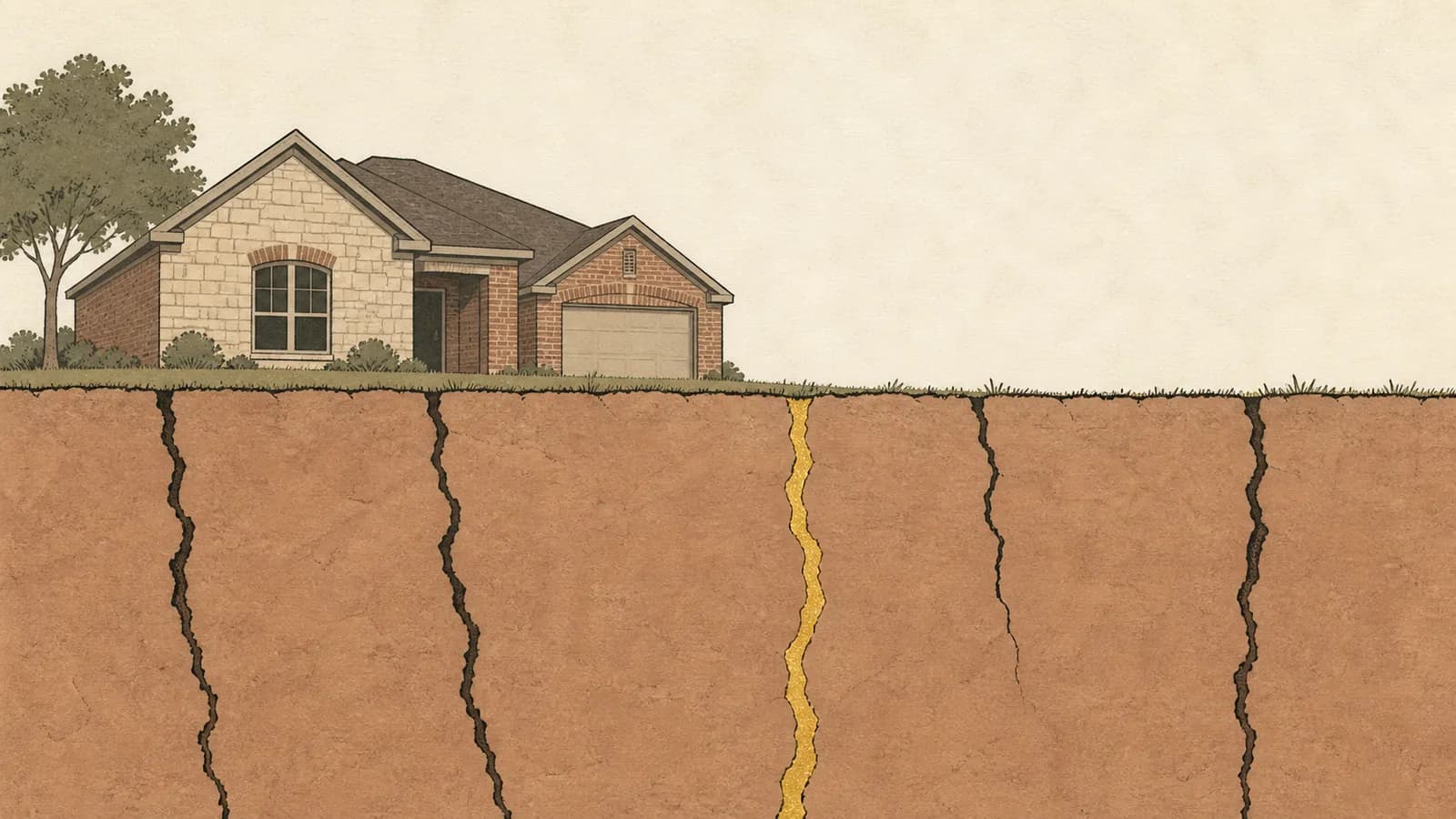
The Blackland Prairie is dominated by Houston Black clay, the Texas state soil: 40 to 60 percent clay, high shrink-swell potential, with cracks half an inch to four inches wide at a foot down that stay open 90 to 150 days a year, per the USDA-NRCS Official Series Description.
Wet, it swells. Dry, it contracts. A slab sitting on it moves with it. That is the whole mechanism.
What surprises buyers is how unevenly that exposure is spread across the metro. Share of mapped acreage rated very high for shrink-swell, from NRCS soil survey data:
| County | Very high shrink-swell |
|---|---|
| Collin | 67.6% |
| Kaufman / Rockwall | 59.5% |
| Dallas | 42.7% |
| Tarrant | 33.7% |
| Denton | 31.9% |
Queried from USDA-NRCS SSURGO as share of mapped acreage with a linear extensibility percent of 9 or above. Rockwall County has no standalone soil survey and cannot be separated from Kaufman.
Collin County is roughly twice Denton County’s exposure. That is not a reason to avoid a county. It is a reason to take the inspection more seriously where the base rate is higher, and it is worth knowing when you are comparing Frisco against Plano or the Collin corridor against Flower Mound and Denton.
What Is Normal Movement
Nearly every house in this region shows some evidence of soil movement. The useful distinction is not whether there is movement but what kind.
Generally unremarkable: hairline cracks in drywall at door and window corners, small cracks in brick mortar joints, minor separation at trim, doors that stick seasonally and free up again. These are the visible expression of a house responding to a wet spring and a dry August.
Worth a closer look: stair-step cracking through brick that widens over time, doors and windows that will not latch at all, noticeably sloping floors, separation at the top of walls, cracks you can put a coin into, and any of these getting worse over months rather than staying stable.
The critical variable is whether the movement is active or historic. A house that moved fifteen years ago, was repaired, and has been stable since is a very different asset from one moving now. Nothing in a visual inspection distinguishes them reliably, which is the reason for the next section.
Who Is Allowed to Tell You What
This trips up nearly every buyer and it is a legal division rather than a professional courtesy.
- A TREC home inspector must tell you whether the foundation is performing. Under 22 TAC 535.228(a) they render a written opinion as to performance and report visible indications such as doors that will not latch, sloping floors and cracked masonry cladding.
- A TREC home inspector may not tell you what caused it or how to fix it. The Texas Board of Professional Engineers, in Advisory Opinion 43, holds that analysing the cause of a condition or recommending repair is the practice of engineering. An inspector cannot give an engineering opinion on a foundation unless they also hold a PE licence.
- A structural engineer can. That is a separate engagement, it costs money, and it takes days.
- A foundation repair company will tell you that you need foundation repair. They may be right. They are also the party selling the repair, which is why an independent engineering opinion first is the correct sequence.
The practical implication is a timing one: negotiate an option period long enough to absorb a second engagement, rather than the shortest one that wins the offer. How the days are counted.
One related restriction worth knowing in advance: hydrostatic plumbing testing must be separately authorised by the seller in writing under paragraph 7A. You cannot order it unilaterally, and a leak under a slab is one of the common causes of movement here. Ask early.
Insurance and Financing Consequences
Two consequences that catch people after the inspection conversation has already been had.
Insurance. The Texas Department of Insurance notes that earth movement is generally excluded from standard homeowners policies and that foundation and slab damage is an optional endorsement rather than standard coverage. Check your specific policy rather than assuming, and raise it when you shop coverage before closing. More on insurance here.
Financing. Fannie Mae will not purchase a loan on a property rated C6 for condition, and evidence of abnormal settlement requires appraiser comment plus a professionally prepared report under Selling Guide B4-1.3-06. In practice that means a serious unaddressed foundation problem can make a house unfinanceable on conventional terms, which shrinks the buyer pool to cash.
What It Costs, and Why I Will Not Quote You
I am going to disappoint you deliberately here, and it is worth explaining why rather than just declining.
There is no government, academic or appraisal source publishing DFW per-pier pricing, and contractor estimates for the same house differ by roughly tenfold. Any confident local number you find online is somebody’s marketing.
The only dated non-contractor figures available are national averages. HomeAdvisor put the average foundation repair job at $5,176 with a typical range of $2,225 to $8,135, and a structural engineer inspection at $340 to $780, as of June 2026. Treat those as a rough national shape rather than a quote for your house.
Get two real bids, after an independent engineering opinion. That sequence, engineer first then bids, is the difference between buying a repair you need and buying one you were sold.
What a Foundation History Does to Value
This is the question sellers ask and the answer is not the one they expect. Three states, three different effects:
| State | Effect on value |
|---|---|
| No symptoms, no history | Baseline |
| Repaired, engineered, warranty transferable | Small discount at most, and sometimes none. The problem is solved and documented |
| Visible symptoms, no report, no repair record | The largest discount of the three, because every buyer must price the worst case |
The lesson for a seller is counterintuitive and important: documentation is worth more than silence.A buyer looking at symptoms with no paperwork assumes the maximum. A buyer looking at an engineer’s report and a transferable warranty is looking at a solved problem. Note also that the Texas seller’s disclosure asks about known conditions, and known problems have to be disclosed. What you have to disclose.
What an Owner Can Actually Do
Movement is driven by moisture change, so the practical management is moisture management. None of this is exotic and all of it helps:
- Water the foundation in summer. Consistent, moderate moisture around the perimeter is better than letting the clay dry out and then soaking it. Soaker hoses set back from the slab are the usual method.
- Fix drainage. Grade should fall away from the house. Gutters should discharge well away from the slab, not at the corner of it.
- Watch large trees near the slab. Mature trees draw enormous quantities of water out of clay in summer, which is a common local cause of localised movement.
- Fix plumbing leaks quickly. A slow leak under a slab changes the moisture content in one place, which is exactly the condition that produces differential movement.
- Keep the records. Engineering reports, repair invoices, warranty documents. They are worth real money when you sell.
Finally, perspective. Houses in this region move. That is a known, priced, manageable characteristic of the market, not a scandal. The buyers who get hurt are the ones who either ignore it entirely or panic at the first hairline crack, and both mistakes are avoidable with one engineering opinion.
Frequently Asked Questions
Why do foundations crack in North Texas?+
The Blackland Prairie is dominated by Houston Black clay, the Texas state soil, which is 40 to 60 percent clay with high shrink-swell potential. It expands when wet and contracts when dry, and the USDA-NRCS Official Series Description records cracks half an inch to four inches wide at a foot down that stay open 90 to 150 days a year. Slab foundations sitting on that soil move with it.
Is foundation movement normal in Texas?+
Some movement is expected in this soil and most houses in the region show evidence of it. What matters is whether the foundation is performing its intended function, whether the movement is ongoing or historic, and whether it has caused damage to the structure. Those are different questions and only the first is one a home inspector can answer.
Which DFW counties have the worst soil for foundations?+
Exposure varies a lot across the metro. Queried from USDA-NRCS SSURGO as the share of mapped acreage with a linear extensibility percent of nine or above, Collin County is around 67.6 percent, Kaufman and Rockwall around 59.5, Dallas 42.7, Tarrant 33.7 and Denton 31.9. Collin County is roughly twice Denton County's exposure.
Does foundation repair hurt resale value in Texas?+
A documented, engineered repair with a transferable warranty is far better for value than an unaddressed problem, and buyers who have been through the process generally understand that. What genuinely damages value is uncertainty: visible symptoms with no engineering report, no repair record and no warranty, which forces every buyer to price in the worst case.
Does homeowners insurance cover foundation repair in Texas?+
Generally not as standard. The Texas Department of Insurance notes that earth movement is typically excluded and that foundation and slab damage is an optional endorsement rather than standard coverage. Read your own policy rather than assuming, and ask specifically about the endorsement when you shop coverage before closing.
Run Your Own Numbers
About the Author

Licensed Realtor · DFW North Texas
Specializing in Plano, Frisco, McKinney, and Allen. Helping buyers and sellers navigate North Texas since 2015, with honest advice, deep local knowledge, and no pressure.
You Might Also Like
What a Texas HOA Can and Cannot Make You Do
State law overrides deed restrictions in more places than owners realise: solar, flags, religious displays, rain barrels, and a real foreclosure power.
· 6 min read
The Over-65 Property Tax Exemption in Texas: The Tax Ceiling
An extra $60,000 off school value in 2026, and a school tax ceiling that freezes the bill. How the ceiling works, how it transfers, and how to defer entirely.
· 6 min read
North Texas Real Estate Market 2026: Buy, Sell, or Wait?
An honest read on the DFW housing market in 2026 - prices, inventory, mortgage rates, and what they mean for buyers and sellers in Plano, Frisco, and beyond.
· 7 min read