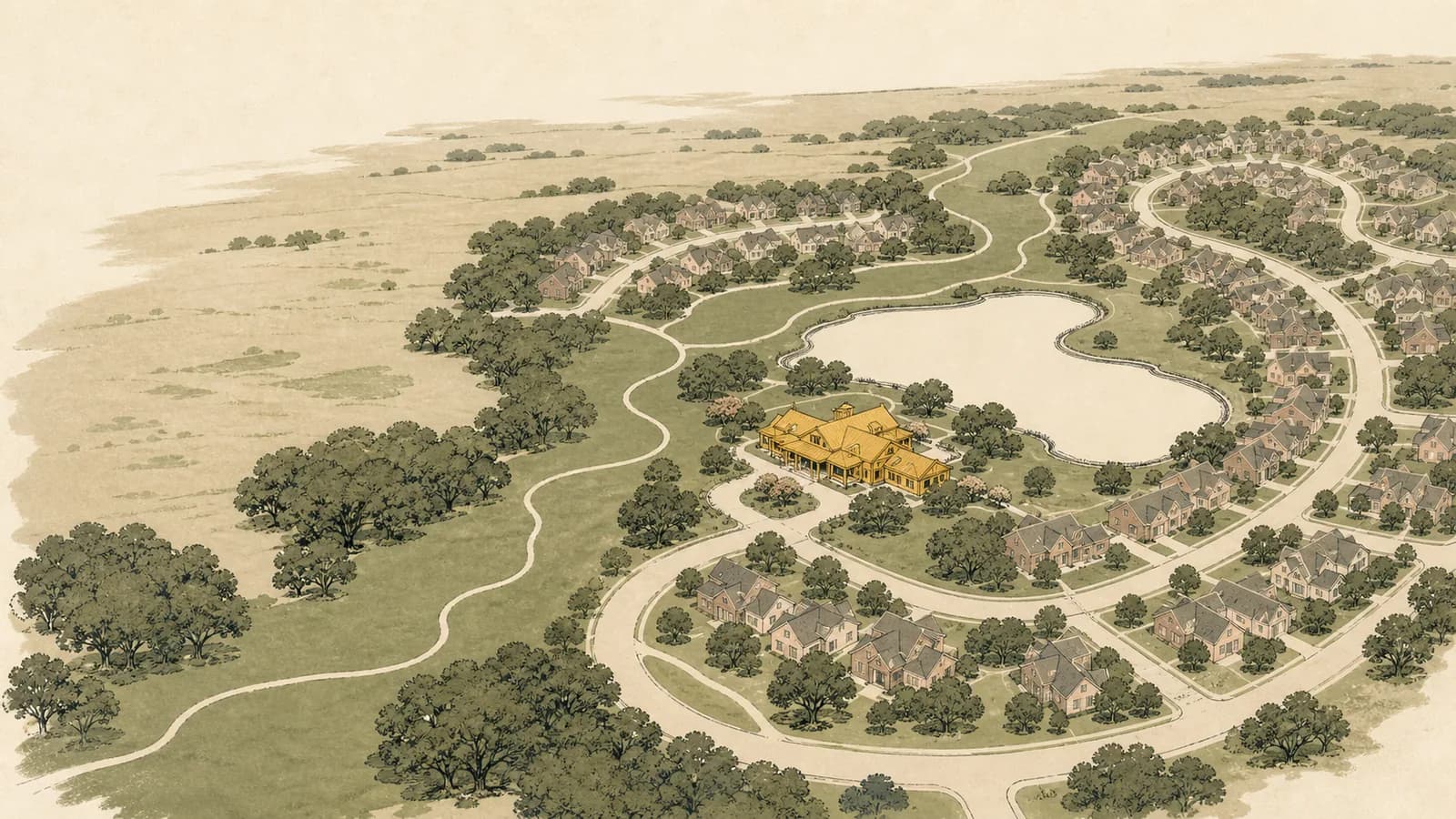
North Texas Master-Planned Communities: How to Compare Them
Amenity centres, trail miles and an HOA that runs like a small government. What the assessments buy, what they do not, and how build-out changes the deal.
A master-planned community is a house plus a subscription to a small private government, and buyers compare the houses carefully and the subscription hardly at all.
What You Are Actually Buying
Four things, only one of which is the house:
- The house and lot. The part everyone evaluates.
- Access to shared amenities, funded by ongoing dues.
- Standards enforced on your neighbours, which is the real product for a lot of buyers, and enforced on you, which is the same thing seen from the other side.
- A share of a long-lived organisation with a budget, reserves, liabilities and the authority to assess you.
That fourth item is where the risk lives and where almost nobody looks. An association with thin reserves and ageing amenities is a special assessment in waiting. What a Texas association can enforce.
The Money: Three Separate Layers
Two houses at the same price in two different communities can have very different annual costs, and the difference is invisible on a listing.
| Layer | What it funds | How long it lasts |
|---|---|---|
| HOA dues | Amenities, common areas, management, reserves | Indefinitely, and they rise |
| Sub-association dues | A specific neighborhood inside the master plan | Indefinitely, on top of the master fee |
| PID or MUD assessment | Public infrastructure debt | Often decades, and it is on the tax bill |
The sub-association layer catches people constantly. A quoted master fee of ninety dollars a month can be joined by a sub-association fee that doubles it. Always ask for the total monthly obligation for the specific address, not the headline figure.
And ask separately about a PID or MUD, because those sit on the tax bill rather than in the HOA statement and can exceed both. What a PID actually is, and how all three differ.
Where the Community Sits in Its Life Cycle
The same community is a very different purchase at three different moments, and this is the single most useful lens for comparing options.
- Early phase. Lowest prices, most uncertainty. Construction traffic, dust, amenities on a plan rather than in the ground, and a builder actively selling against your resale if you need to move. The upside is that you bought before the community existed.
- Mid build-out. Amenities partly delivered, some phases finished. Usually the hardest phase to sell into, because the builder is still competing with you. What that looks like.
- Built out. Highest prices, everything delivered, trees maturing, the developer gone and the association run by residents. The risk shifts from construction disruption to whether the association was handed over with adequate reserves.
Neither end is better in general. Early suits a long holding period and a tolerance for disruption. Late suits somebody who wants the finished product and will pay for it.
How to Compare Two Communities
Put both on the same sheet, on these lines, and the differences become obvious:
- Total monthly HOA obligation for the specific address, master plus sub
- PID or MUD assessment, amount and remaining years
- Combined property tax rate for the exact parcel
- Which amenities exist today, physically, and which are on a plan
- Reserve funding, from the reserve study rather than the brochure
- Phasing plan: what is still to be built, where and roughly when
- School district and campus for the address, and any planned boundary changes
- Lot sizes and what backs the lots you are considering
- Architectural rules, and how quickly the committee actually responds
- Rental restrictions, if you might ever let the house
Most of that is in documents you are entitled to during the option period. Read them then, not after. What the option period is for.
The Established North Texas Examples
Worth touring even if you end up elsewhere, because they show what a finished community actually looks like:
- Stonebridge Ranch, McKinney. Around 6,800 acres and more than thirty sub-neighborhoods built over three decades, with a members-only beach club, an aquatic centre and more than twenty miles of trails. Master HOA around $96 a month plus sub-association dues.
- Craig Ranch, McKinney. About 2,200 acres around a championship golf course, mostly Frisco ISD, with dues in the $175 to $225 range reflecting a heavier amenity package.
- Twin Creeks, Allen. Golf, multiple pools, mature trees and a long resale record, at around $100 a month.
- Heritage Ranch, Fairview. Gated and age-restricted with golf, and a useful example of how a specialised community trades a narrower buyer pool for a distinct identity. More on that category.
The newer generation, in Prosper, Celina and the northern corridor, offers larger lots and newer product at the cost of being earlier in the life cycle described above. Prosper vs Celina.
Ten Questions Before You Choose
- What is the total monthly HOA obligation for this exact address?
- Is there a PID or MUD, how much, and how many years remain?
- Which amenities are built today, and which are on the site plan?
- May I see the reserve study and the last two years of financials?
- Has there been a special assessment, and is one anticipated?
- What have dues done over the last five years?
- When does control transition from the developer to the residents?
- What is left to build, where, and on what timeline?
- Are there rental restrictions or caps?
- What does the architectural committee require, and how long do approvals take?
A sales office that answers all ten clearly and in writing is telling you something good about the community. One that gets vague on the reserve study is telling you something as well.
Frequently Asked Questions
What is a master-planned community?+
A large development planned as a whole rather than built subdivision by subdivision, typically with its own amenity centres, trails, parks and sometimes schools, governed by a homeowners association with substantial authority. In North Texas they range from a few hundred homes to communities of several thousand built over decades.
Are master-planned communities worth the HOA fees?+
It depends entirely on whether you use what the dues buy. Pools, trails, fitness facilities and programming are genuinely good value for a household that uses them weekly and a recurring cost for one that does not. Compare the dues against what you would otherwise pay for equivalent access.
What is the difference between HOA dues and a PID assessment?+
HOA dues fund the association's operations and amenities and are set by the association. A PID assessment repays public infrastructure through your tax bill, often for decades, and is set by the district rather than the association. A community can have both, and a house can look identically priced to one that has neither.
Is it better to buy early or late in a master-planned community?+
Early usually means lower prices and years of construction, unfinished amenities and uncertainty about what gets built. Late means paying more for a finished environment with the amenities in place and the builder gone. Which is better depends on your holding period and your tolerance for living on a construction site.
What happens when the developer leaves a master-planned community?+
Control of the association transitions from the developer to the homeowners, which is a significant moment. What matters is whether the association is handed over with adequate reserves and a realistic budget. Ask for the reserve study and the transition timeline, because an underfunded handover becomes a special assessment later.
Run Your Own Numbers
About the Author

Licensed Realtor · DFW North Texas
Specializing in Plano, Frisco, McKinney, and Allen. Helping buyers and sellers navigate North Texas since 2015, with honest advice, deep local knowledge, and no pressure.
You Might Also Like
What a Texas HOA Can and Cannot Make You Do
State law overrides deed restrictions in more places than owners realise: solar, flags, religious displays, rain barrels, and a real foreclosure power.
· 6 min read
How to Choose a North Texas City (and How Ours Is Scored)
Nine factors, every score derived from a citable anchor - TEA ratings, Walk Score, ACS commute times. Including the data we deliberately refuse to use, and why.
· 8 min read
Allen, TX Real Estate: The City With One High School (2026)
Allen, TX has 114,000 people and one comprehensive high school - which explains the 18,000-seat stadium. A buyer’s look at prices, schools, and commute.
· 7 min read