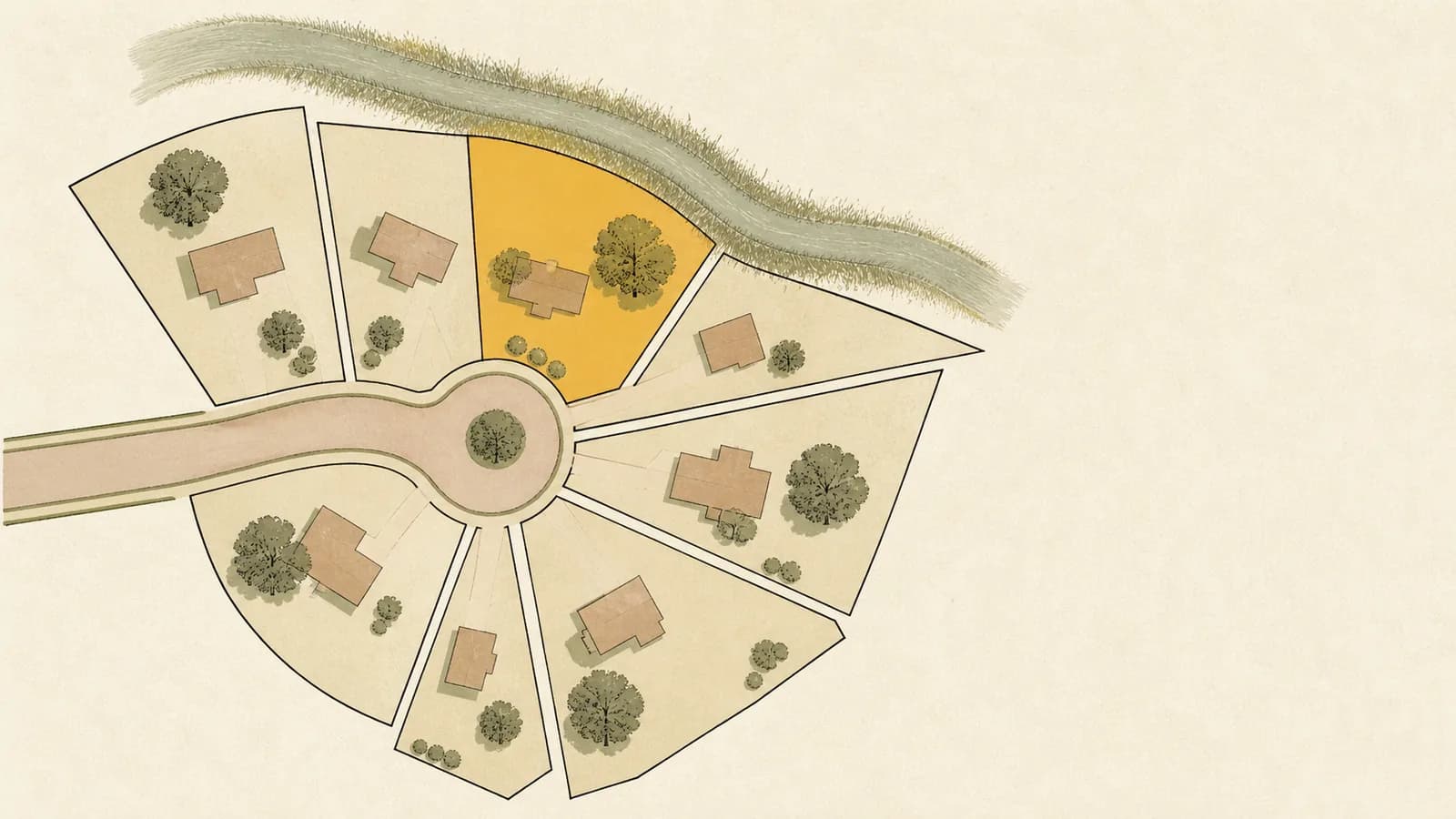
How to Choose a Lot in a North Texas New Build
The lot premium is the least reversible decision in the whole purchase. Drainage, orientation, easements, and the greenbelt that becomes a road.
You can change the countertops, the floors, the paint, the layout and eventually the roofline. You cannot change which piece of ground the house sits on.
Buyers spend hours in the design centre choosing finishes that will be replaced in fifteen years, and minutes choosing a lot they will live with for the entire time they own the house. Reverse that.
Why the Lot Outlives Everything Else
Three reasons, and the third is the one people notice too late:
- It is permanent. Every other decision in a new build is revisable at some cost. This one is not revisable at any cost.
- It drives resale. When you sell, buyers will compare your house to the identical floor plan three streets over. The lot is the differentiator, and it is the only one.
- It determines your daily experience of the house. Afternoon sun, road noise, whether water pools in the yard, whether the back fence looks at trees or at a retaining wall.
Drainage, Which Matters More Here Than Anywhere
This is first on the list for a specific North Texas reason. Rainfall here arrives in short, intense events rather than steady drizzle, and it lands on expansive clay that does not absorb it quickly. Where water goes on your lot is not a cosmetic question.
What to establish:
- Is the lot at the low point of the block? Water flows downhill and it will find you. Stand at the property and look at the grade of the whole street rather than just the lot.
- Where is the drainage easement, and does it cross your lot? It will be on the plat. A drainage easement running through the back third of a yard rules out a pool and a shop.
- Is there a detention or retention pond nearby, and who maintains it?
- Does the finished floor elevation sit well above the surrounding grade?
- Go and look after a heavy rain. This is the single most useful hour you can spend.
Poor drainage in clay soil is not just a wet-yard problem. Uneven moisture around a slab is exactly the condition that produces differential foundation movement, which is the most expensive category of repair in this region. Why moisture management matters here, and the wider weather picture for buyers.
Orientation in a Texas Summer
In a mild climate this is a preference. Here it is a cost, and it shows up on the utility bill and in whether you use your own back yard between May and September.
- West-facing rear elevation. Full afternoon sun on the back of the house and the patio, through the hottest part of a long day. Higher cooling load, faster degradation of outdoor materials, and a yard that is unusable until well after dinner in summer.
- North and east-facing rear. Shade when you actually want to be outside. Generally the most comfortable orientation here.
- West-facing front. The garage and driveway absorb the afternoon heat instead of the living space, which many people prefer.
None of this rules a lot out. It is worth a real amount of money over the years you own it, which means it belongs in the comparison rather than being noticed after you move in.
What Backs the Lot, and What Will
The most common expensive mistake in North Texas new construction: paying a premium for a view of open ground that was never protected.
Ask for, and read, these documents before you choose:
- The recorded plat for the community, showing lots, easements and dedicated open space.
- The full community phasing plan, showing what is still to be built and roughly when.
- The city’s thoroughfare plan, which shows planned road alignments and widenings. A future six-lane arterial behind your fence is a public document today.
- The city’s zoning and land use mapfor the adjoining parcels. “That field will always be a field” is true only if somebody wrote it down.
The distinction that matters: dedicated open space, a floodway, or a permanently protected greenbelt is durable. Undeveloped land is not. Pay a premium for the first, be sceptical about the second.
Also worth checking what backs the lot at ground level rather than on a plan:
- An arterial road behind a fence is a noise source for the life of the house
- A retail parking lot means lights and delivery traffic
- A school means predictable, twice-daily congestion
- A retention pond can be lovely and can also be mosquitoes
- Overhead transmission lines affect both view and resale
The Walk-the-Lot Checklist
Go and stand on the dirt. Twice, at different times of day. Then check:
- Where does water go, and where is the low point of the street?
- Which way does the rear elevation face?
- What backs it today, and what does the plat, phasing plan and thoroughfare plan say backs it later?
- Where are the easements, and what do they rule out?
- How far is the nearest arterial, school, retail entrance or amenity centre?
- Is the usable rear yard actually big enough for what you want to put in it?
- Where do the utility boxes, transformers and fire hydrants land relative to your frontage?
- What is the noise like at 7am and at 6pm?
Finally, one financial note that belongs in this decision: check whether the community carries a PID assessment or a MUD, because that changes the annual cost of every lot in it and is frequently not mentioned in the sales office until the contract. HOA vs MUD vs PID.
Frequently Asked Questions
Are lot premiums worth it in new construction?+
Some are and some are not. Premiums for a genuinely irreplaceable feature, such as backing permanent open space or a cul-de-sac position, tend to hold their value because the next buyer wants the same thing. Premiums for a slightly larger lot in the middle of a block frequently do not return, because the difference is not visible from the street.
What should I look for when choosing a lot?+
Drainage first, then what backs it, then orientation, then easements, then the shape and usable area. Drainage is first because it is the one that produces expensive, recurring problems and it is the one buyers most reliably ignore when standing on a dry lot on a nice day.
Is it bad to buy a house that backs onto a greenbelt?+
It is usually excellent, provided the greenbelt is permanently protected rather than simply undeveloped land. Ask for the recorded plat and the city's thoroughfare and land use plans. Plenty of North Texas buyers have paid a premium for a view that turned into a road or another phase of houses.
Does the direction a house faces matter in Texas?+
More than in most climates. A west-facing rear elevation takes the full afternoon sun through a long summer, which affects cooling costs, how usable the yard is after work, and how quickly outdoor materials degrade. North and east-facing rear yards are meaningfully more comfortable from May to September.
What is a lot easement and why does it matter?+
It is a recorded right for someone else to use part of your land, most often a utility or drainage easement. You still own the ground and you generally cannot build on it, and the holder can access it. That can rule out a pool, a shop or a fence line exactly where you planned to put them, so check the plat before you choose.
Run Your Own Numbers
About the Author

Licensed Realtor · DFW North Texas
Specializing in Plano, Frisco, McKinney, and Allen. Helping buyers and sellers navigate North Texas since 2015, with honest advice, deep local knowledge, and no pressure.
You Might Also Like
PID Assessments in North Texas: What Outlasts the Builder
A public improvement district repays infrastructure through your tax bill for decades. How to find one before you offer, and what paying it off really costs.
· 6 min read
North Texas Master-Planned Communities: How to Compare Them
Amenity centres, trail miles and an HOA that runs like a small government. What the assessments buy, what they do not, and how build-out changes the deal.
· 5 min read
Wylie, TX: A Wylie Address Doesn’t Mean Wylie ISD (2026)
Wylie spans three counties and five school districts - the mailbox address won’t tell you which school your kid attends. What to verify first, plus prices.
· 7 min read